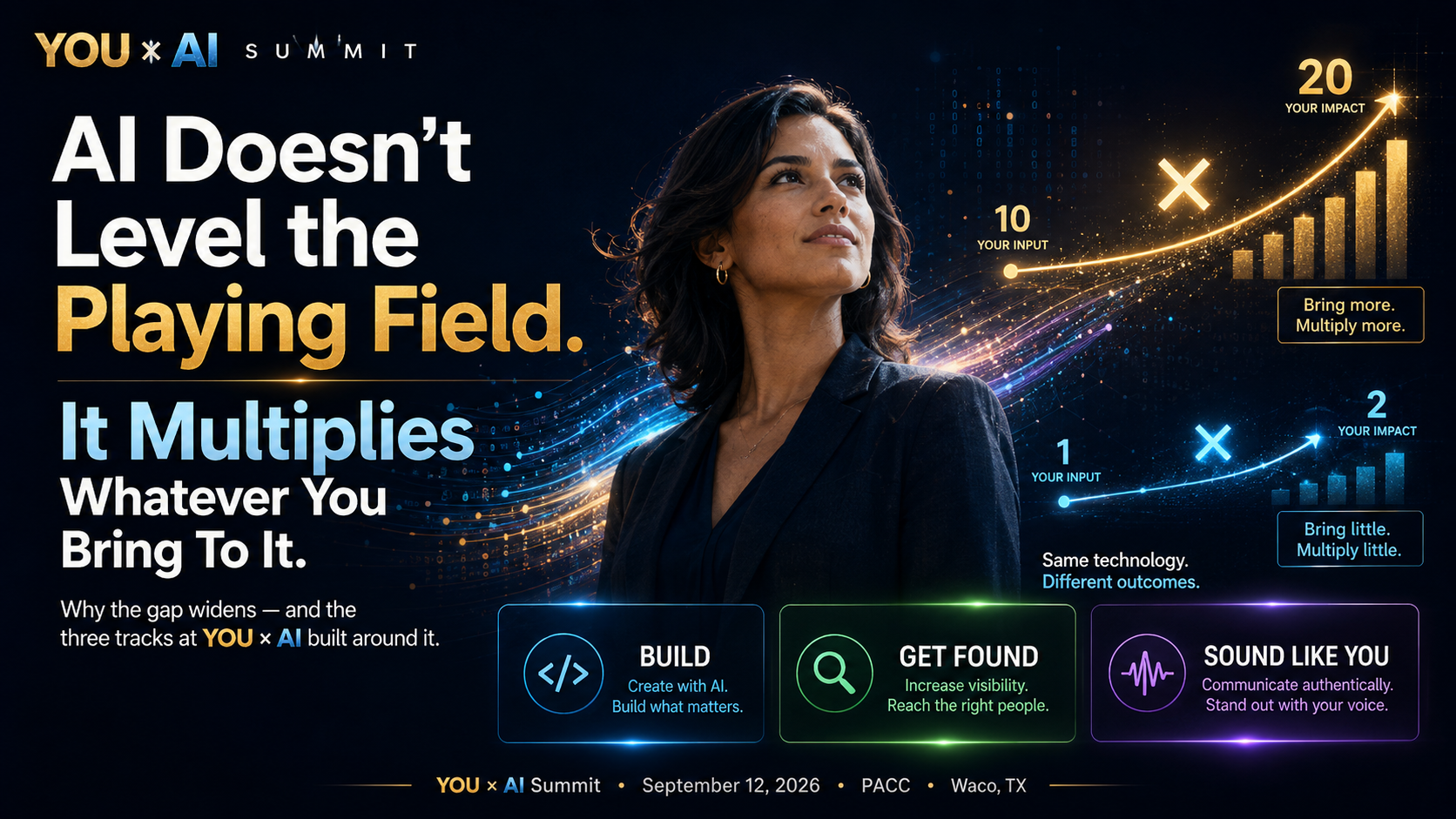
Most business owners believe AI is the great equalizer. The tools are cheap, everyone has access, and the small operator can finally compete with the big one.
That belief is backwards, and the arithmetic is simple enough to do on a napkin.
AI is a multiplier, not an addition. Multipliers don’t close gaps — they widen them.
Say you bring a 1 to the table: no clear point of view, nothing distinctive, work that could have come from anyone. Your competitor across town brings a 10 — a real specialty, a reputation, a way of seeing the problem that’s genuinely theirs. Now AI gets twice as good, for both of you. You go from 1 to 2. They go from 10 to 20.
The gap between you grew from 9 to 18. AI improved for both of you and they pulled further ahead.
That’s the whole premise of this summit, and it’s why the name is an equation with a multiplication sign in it: YOU × AI. Multiplication is unforgiving in a way addition isn’t. Anything × 0 is still 0. If you bring nothing distinctly yours to AI, no amount of AI produces anything worth having.
Dr. Hope Koch of Baylor University, who closes the day, puts the same idea in plainer terms: humans plus AI beats AI alone, and it also beats two humans alone. The value is in the combination — and one half of that combination is the only part that isn’t becoming free.
So the practical question stops being “how do I learn AI?” and becomes something more useful: what do I bring to it?
There are three honest answers, and each one is a track.
Build: the “how” stopped being the obstacle
For most of business history, the gap between having an idea and having the thing was money and technical skill. You wanted a tool, an app, a system that ran without you — and you needed a developer, a budget, and six months.
That barrier is gone. Not reduced — gone.
The constraint now isn’t capability. It’s knowing what to point the capability at. Which means the scarce ingredient is your understanding of your own business: what actually wastes your week, where the work piles up, which decision you keep making by hand.
The Build track is hands-on. Bring a laptop. You leave with something that works — not notes about something you might build later.
Chrissy McDannell runs a session where you build an actual AI assistant during the hour. April Leman — who says it best: “Neither of us codes for a living. We’re just tech-curious and we got good at this the same way you will: by building real things, not reading about them” — walks you through building a real automation workflow. Jackye Clayton starts with a vague prompt about making the perfect pizza crust and turns it into a reusable AI workflow, live, which is the most disarming way anyone has explained this.
The rest of the track is proof that the barrier is down. Dariia Isyk is a Baylor finance student who built an AI platform for students and has secured more than $1.5 million in scholarships and educational funding, alongside her co-founder Shakhlo Juraboeva. Michael Wellborn built a system that automates venture-capital research and pitch customization for his own startup — the most relationship-dependent work a founder does. Katie Selman-Green builds AI workflows that become repeatable team practice instead of one-off hacks. Jermaine Malcolm works on what happens when a whole community gets these tools, not just individuals. Mito Diaz-Espinoza runs the Cen-Tex Hispanic Chamber of Commerce and speaks on moving past one-off prompts to an AI setup built around your own goals and workflow.
What you leave with: a working thing, and the end of “I’m not technical enough for this.”
Get Found: being the one they find
Something changed in how people look for businesses, and most owners haven’t priced it in yet.
Your customer used to search. Now, increasingly, they ask. They open ChatGPT, Claude, Gemini or Perplexity and say “who should I hire for this?” — and a machine gives them a short list. If your name isn’t on it, you were never in the running. There’s no page two to be on.
Here’s the part that connects back to the equation. Asked directly whether it can cite a company that has nothing distinctive to say, Perplexity answered plainly: AI systems prefer pages that add something the model cannot safely infer on its own.
Read that again, because it’s the whole game. An engine recommends you only when it can’t make the point without you. If everything on your website is something a machine could have written unaided, there’s nothing to quote — so there’s nothing to cite. Sameness stopped being a branding problem and became a retrieval failure.
Tommy Landry has spent over a decade on the mechanics of this and wrote the book on the transition from SEO to AEO to GEO. Andrew Lane — who helped scale Copy.ai from 28,000 to 10 million users — makes the same argument from the other direction: “AI just gives them a faster way to improvise. Instead of leverage, they get faster chaos.” That’s the multiplier problem stated in business terms.
What you leave with: a clear picture of what the engines currently say about your business, and what to do about it.
Sound Like You: the part AI can’t fake
Everyone got the same tools at the same time. Which means everyone’s output started sounding the same at the same time.
You can feel it now — the tells in a paragraph, the contrast that isn’t a real contrast, the vocabulary nobody uses out loud. Russ Henneberry calls generic AI output boiled chicken, and once you’ve heard it you can’t unhear it. It’s technically food. Nobody remembers it.
The fix isn’t using less AI. It’s giving AI something only you have: your actual stories, your specific clients, the mistake you made in 2019 that changed how you work, the way you explain the thing to a friend at a bar. Fed real context about a real person, these tools stop producing beige and start sounding like you. Fed nothing, they produce what everyone else gets.
Kennisha Thornton is a KWTX news producer and storyteller who uses AI to sharpen creativity and amplify authentic voices, drawn from journalism, publishing, and podcasting. Sara Lohse coaches entrepreneurs to uncover and share the stories that make them unforgettable. Sam Harper built The Waco Buzz into a local publication with a five-figure readership by having a voice that reads like a person, not a press release.
On the main stage, Bryan Eisenberg — who coined Persuasion Architecture — opens the day with the argument underneath all of it: the brands that win in the age of AI are the ones whose story aligns with the story their buyer is already trying to live.
What you leave with: the ability to use these tools at full volume without disappearing into the noise everyone else is making.
Why one day, and why Waco
The tracks run concurrently, which means you’ll miss things. That’s deliberate. A day that tries to give everyone everything gives nobody anything, and the sessions are hands-on precisely because watching someone else build is not the same as building.
As for Waco: the absence of a legacy tech ecosystem has turned out to be a kind of freedom. There’s no established way things are done here, which leaves only the interesting question — what do you actually want to make? Mike Hamilton of Rogue Media Network opens the day with that story, because it’s the reason this is happening here and not in Austin.
And there’s a clock on all of it. Right now, nearly everybody is a beginner. That will not be true in a year. The tools will be dramatically better, and the people who started this year will have had a year of practice with them. The gap you’d have to close in 2027 is bigger than the gap you’d close on September 12.
YOU × AI Summit — Saturday, September 12, 2026 · PACC, Waco, Texas · 8:00 AM to 5:00 PM. Nineteen practitioners, three tracks, one day.